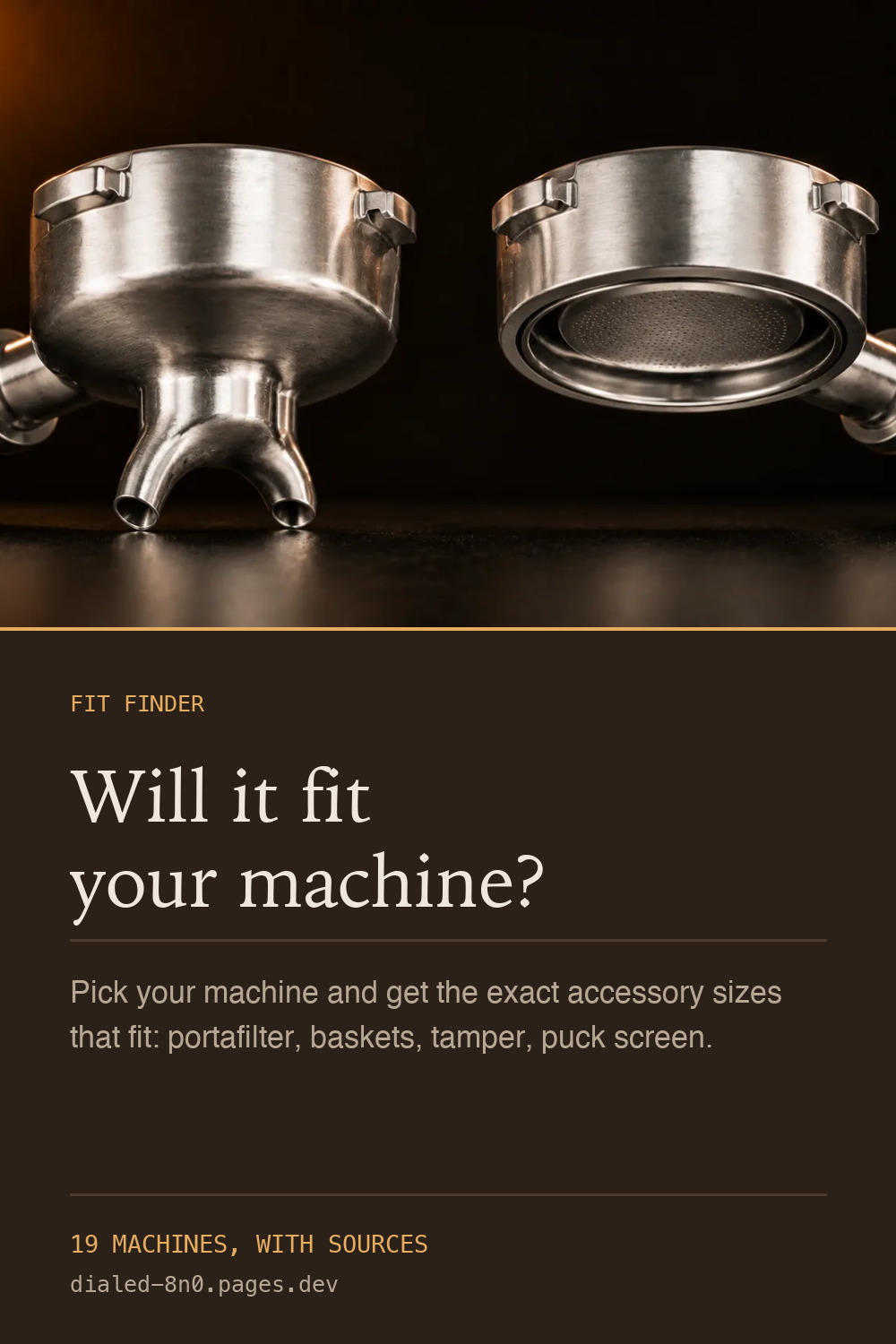
Which accessories actually fit your espresso machine?
Pick your machine and get the exact sizes — portafilter, baskets, tamper, puck screen, funnel. Most “54 mm” machines do not take a 54 mm tamper, which is why so many tampers get returned. No prices here, just what fits.

Note for the Barista Express: Built-in grinder: some magnetic dosing funnels block the auto-dose cradle. Check the listing says it clears the grinder.
Note for the Barista Express Impress: The assisted tamp mechanism expects the stock basket depth — precision baskets can change the tamp feel.
Note for the Barista Pro: Built-in grinder: check dosing funnels clear the auto-dose cradle.
Note for the Barista Touch: Sources conflict on this model. Most retailers list it in the 54mm family; confirm against your manual before buying.
Note for the De’Longhi Dedica / Dedica Arte (EC680 · EC685 · EC885): The Dedica ships with a pressurised basket, which masks grind quality. Moving to a non-pressurised 51 mm basket is the usual first upgrade — but it only pays off once you have a real grinder.
Note for the Lelit Anna (PL41): ★ 57 mm, not 58 mm. Lelit’s 57 mm format (LELIT57) is one millimetre off the commercial standard, so 58 mm tampers, baskets and bottomless portafilters will not fit. The aftermarket is noticeably narrower — check every listing says 57 mm.
Note for the De’Longhi Linea Classic (EM450M): Sold with pressurised baskets. The 51 mm parts that fit the Dedica fit this machine too, but check the listing names your model — De’Longhi uses more than one portafilter format across its range.
Note for the Profitec GO: Shares the Profitec 58 mm portafilter with the Pro 300 / 400 / 500 / 600 / 700, so parts are interchangeable across that range.
Note for the Profitec MOVE: E61-group machine, so it takes the same 58 mm portafilter as the rest of the Profitec E61 range.
De’Longhi’s 51 mm is its own ecosystem. Parts sold for Breville (54 mm) or prosumer machines (58 mm) will not fit, so filter every listing by 51 mm.
| Part | Size | Why it matters | |
|---|---|---|---|
| Portafilter | 51 mm | De’Longhi uses its own 51 mm size. Neither 54 mm (Breville) nor 58 mm (commercial) parts will fit. | Check price ↗ |
| Filter baskets | 51 mm | ★ The stock basket is pressurised — it forces crema regardless of grind, which hides both good and bad grinding. A non-pressurised 51 mm basket is the standard upgrade, but only makes sense with a real grinder. | Check price ↗ |
| Tamper | 51 mm | Must be 51 mm. The plastic scoop-tamper in the box is the single biggest limiter on this machine. | Check price ↗ |
| Dosing funnel | 51 mm | Sits on the portafilter rim so grounds do not spill. | Check price ↗ |
| Puck screen | 51 mm | Sits on top of the puck. Sold for the Dedica in 51 mm, typically around 150 µm mesh. | Check price ↗ |
| Distribution / leveller | 51 mm | Levels the grounds before tamping. Adjustable-depth versions let you match the shallow 51 mm basket. | Check price ↗ |
| WDT tool | Universal | Needles break up clumps. Not size-specific — and it matters more here than on any other machine, because the basket is small. | Check price ↗ |
| Knock box | Universal | Not size-specific. | Check price ↗ |
| Scale | Slim preferred | The Dedica is very narrow with little clearance under the spouts — a slim scale fits best. | Check price ↗ |
Accessories are shared across this whole family. Anything sold for the Barista Express, Barista Pro or Bambino will fit the Bambino Plus, and vice versa.
| Part | Size | Why it matters | |
|---|---|---|---|
| Portafilter | 54 mm | Bottomless (naked) portafilters for this family are 54 mm. A bottomless basket shows channelling you cannot see otherwise. | Check price ↗ |
| Filter baskets | 54 mm | Stock sizes run roughly single 8–11 g, double 16–18 g, triple 18–22 g. Precision baskets (IMS, VST) are made in 54 mm for this family. | Check price ↗ |
| Tamper — stock basket | 53.3 mm | ★ The single most common mistake. Stock Breville baskets have slightly tapered walls, so a 53.3 mm tamper is the correct fit — not 54 mm. | Check price ↗ |
| Tamper — precision basket | 54.0 mm | Precision baskets have straight walls, so they take a true 54.0 mm tamper. Note that some brands also sell 54.3 mm in this family — that extra third of a millimetre is enough to catch on the wall in some basket and tamper combinations, so 54.0 mm is the safer default unless a maker states otherwise for your exact basket. | Check price ↗ |
| Dosing funnel | 54 mm | Magnetic funnels sit on the portafilter rim. On machines with a built-in grinder, check it still clears the auto-dose cradle. | Check price ↗ |
| Puck screen | 53.3 mm | Sits on top of the puck. Sized slightly under the basket so it drops in — 53.3 mm, not 54 mm. | Check price ↗ |
| Distribution / leveller | 53–53.3 mm | Levels the grounds before tamping. Same tapered-wall logic as the tamper. | Check price ↗ |
| WDT tool | Universal | Needles stir the grounds to break clumps. Not size-specific — any WDT works. | Check price ↗ |
| Knock box | Universal | Not size-specific. | Check price ↗ |
| Scale | Check clearance | Any timer scale works, but the Bambino/Bambino Plus drip tray is shallow — a slim scale fits better under the spout. | Check price ↗ |
The 57 mm Lelit format has a genuinely narrower accessory market than 58 mm — owners on Home-Barista describe hunting for parts as the main frustration of the machine. Two things follow. If a listing only says “fits most prosumer machines”, assume it means 58 mm and skip it. And read the exact number: parts for this group appear as 57, 57.3 and 57.35 mm depending on what they are.
| Part | Size | Why it matters | |
|---|---|---|---|
| Portafilter | 57 mm | ★ One millimetre off the 58 mm commercial standard. A 58 mm portafilter will not fit, and this catches people out constantly. | Check price ↗ |
| Filter baskets | 57 mm | Sold as LELIT57. Fewer precision-basket options exist than for 58 mm — check the listing states 57 mm explicitly. | Check price ↗ |
| Tamper | 57 mm | A 58 mm tamper will not seat correctly. Buy 57 mm. | Check price ↗ |
| Dosing funnel | 57 mm | Match the portafilter size, not the commercial standard. | Check price ↗ |
| Puck screen | 57.3 mm | ★ Note the figure: puck screens for this group are commonly sold as 57.3 mm, not 57.0 mm. Sized to drop inside the basket. | Check price ↗ |
| Distribution / leveller | 57.35 mm | ★ Lelit’s own leveller (PLA472A) is specified at 57.35 mm. This group is sold under 57, 57.3 and 57.35 mm depending on the part — read the exact figure on every listing rather than assuming “57”. | Check price ↗ |
| WDT tool | Universal | Not size-specific. | Check price ↗ |
| Knock box | Universal | Not size-specific. | Check price ↗ |
| Scale | Universal | Any timer scale works. | Check price ↗ |
58 mm is the commercial standard, so most third-party tampers, baskets and screens made for prosumer machines will fit.
| Part | Size | Why it matters | |
|---|---|---|---|
| Portafilter | 58 mm | These machines use the commercial 58 mm standard, so the whole aftermarket is open to you. | Check price ↗ |
| Filter baskets | 58 mm | Typically 18–22 g doubles. IMS and VST precision baskets are widely available in 58 mm. | Check price ↗ |
| Tamper | 58.0–58.5 mm | 58.5 mm gives a tighter fit in most 58 mm baskets; 58.0 mm is the safe default. | Check price ↗ |
| Dosing funnel | 58 mm | Magnetic ring that sits on the portafilter rim. | Check price ↗ |
| Puck screen | 58.5 mm | Sits on top of the puck to keep the shower screen clean. | Check price ↗ |
| Distribution / leveller | 58 mm | Levels grounds before tamping. | Check price ↗ |
| WDT tool | Universal | Not size-specific. | Check price ↗ |
| Knock box | Universal | Not size-specific. | Check price ↗ |
| Scale | Universal | These machines have deeper drip trays, so scale height is rarely a problem. | Check price ↗ |
Spouted or bottomless — what the two portafilter types actually are
Size tells you what will fit. This tells you which of the two shapes to buy in that size.

Pressurised or not — the other thing to check before you buy a basket
Size is not the only variable. Many entry machines ship with a pressurised basket, and it changes what a better grinder can do for you.

The four bore sizes, drawn to scale
| 58 mm | Commercial standard | Dual Boiler · Oracle · Gaggia Classic Pro |
| 57 mm | Lelit | Anna (PL41) — LELIT57 |
| 54 mm | Breville / Sage | Bambino · Barista Express · Barista Pro |
| 51 mm | De’Longhi | Dedica · Dedica Arte |
Does your grinder actually reach espresso?
This is the grinder version of the tamper problem, and it costs a great deal more. Espresso needs a grind fine enough to build resistance, and — just as importantly — a grinder whose steps are small enough to land on it. A grinder that jumps in coarse increments will step straight over the setting you need, so the shot is either gushing or choked with nothing usable in between. That is a resolution problem, not a technique problem, and no amount of practice fixes it.
| Grinder | Adjustment | What that means |
|---|---|---|
| Baratza Encore (non-ESP) | ~90 µm steps | ★ Sources describe it as not an espresso-level grinder: the steps are too coarse to land on an espresso setting. One letter apart from the ESP, and the difference is decisive. |
| Baratza Encore ESP | ~20 µm steps in the espresso range | A dual-resolution collar: fine steps on settings 1–20 for espresso, coarse above. This is the change that makes it usable for espresso where the plain Encore is not. |
| 1Zpresso J-Max | Stepped, very fine | Enough clicks to behave almost like stepless. Note the caveat below on published micron figures. |
| DF64 (Gen 2) | Stepless | 64 mm flat burrs with continuous adjustment, so there is no step to fall between. |
⚠️ Treat published “microns per step” with suspicion. For conical burrs in particular, the figure quoted by the manufacturer often does not survive measurement — the J-Max is specified at 8.8 µm per click, while independent grind-size charts put it nearer 2.6 µm. Use these numbers to compare coarse versus fine adjustment, not as absolute values. Where a maker publishes no figure, we have left it blank rather than guess.
Once the sizes are right, this is what changes the cup
Accessories make a setup pleasant to use. With the exception of moving off a pressurised basket, they do not change what is in the cup very much. If everything fits and the shots still are not what you want, the grinder is almost always the next thing that matters — and it is the part most people under-buy.
That is not a pitch bolted onto the end of a fit guide. It is the same conclusion the rest of this page reaches: a pressurised basket hides grind quality, a tapered basket needs the right tamper, and once both are correct the ceiling on your espresso is set by how evenly the grinder cuts. A tamper is a $30 problem. The grinder is the actual one.
We do not own these and have not tested them; these are the grinders the community consistently points to at each step. As everywhere on this site, no prices are shown — check the current price on Amazon before buying.
Reuse this table. CC BY 4.0 — take it, with attribution. Download as CSV. If you are citing it, cite /sizes — the same table without the buying links:
“Espresso portafilter, basket and tamper sizes by machine”,
  Dialed. https://dialed-8n0.pages.dev/sizes
Machines are listed only where more than one independent source agrees. Where sources conflict the row says so. Makers change formats without renaming models, so check your own manual before you buy.